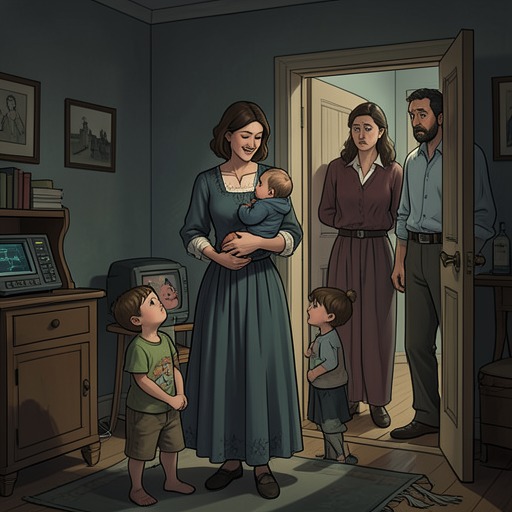
Sunday’s orphanhood and abandonment
Mothering SundaySunday Small’s orphanhood and abandonment shape both her early life at Nuneaton Union Workhouse and her later understanding of what makes a family. Left on the workhouse steps on the day she was born, she grows up without knowing who her parents were or why they left her. Her longing for an explanation persists even after she finds care elsewhere: the possibility of a mother’s return first sustains her, then becomes a loss she must learn to accept.
Identity and Institutional Childhood
Sunday knows that she was abandoned at birth, but not the circumstances behind it. She can only speculate that she was illegitimate, and she cannot tell whether her mother is dead or chose not to keep her. As a child, she invents a hopeful future in which her mother comes back and takes her away to a happier life. That private fantasy stands against the facts she does know: she spent her early years in the workhouse and, in her recollection, Verity Lockett was the only person there to show her kindness.
The institution organizes daily life around separation and labor. Women, boys, girls, and men occupy different sections; the inmates rarely gather together except for Sunday church. Men and stronger boys pick oakum from old ropes, crush bones for fertilizer, or work in the gardens. Women and girls sew uniforms, cook, clean, and labor in the laundry. Sunday experiences the workhouse not as an abstract refuge but as a place where work is assigned, families are divided, and a child’s hopes have little power over her circumstances.
Daily Life and Witness to Institutional Cruelty
Sunday remembers meals of dry grey bread, thick porridge, and often watery soup, with meat only occasionally and then too gristly to chew. Her account to Lady Lavinia Huntley contrasts those meals with the guardians’ provision for feeding residents well. She also describes punishment in a cellar with no bed or blanket, only a bucket, where it was pitch-black, cold, and damp. The longest she was confined there was three days, without food or drink; she emerged so weak that she spent the night in the sickbay. She recalls two younger girls being locked there and never seen again. Miss Frost said they had died of influenza, but Sunday could not remember a proper funeral for them.
Her own history of powerlessness helps explain the force of her response when Cissie Burns is taken away. Sunday has heard Cissie say that Albert Pinnegar forced her, and she sees the asylum carriage arrive after Cissie had been led to expect a place where she could care for her baby. Cissie recognizes the carriage from Hatter’s Hall and fears that, with no one to come for her, she will never be released. Miss Frost instead seizes her and denounces her. When Lady Lavinia Huntley later asks about conditions at the workhouse, Sunday recounts what happened and breaks down as she describes Cissie being taken away. Her testimony connects her own childhood among the institution’s vulnerable residents with her concern for those still trapped there.
Abandonment, Friendship, and Loss
Sunday’s experience makes abandonment more than a fact about her birth: it is a fear she returns to whenever a close bond is threatened. When Daisy Branning recoils from her pregnancy and asks whether the baby could be given away, Sunday challenges her to consider how the child might feel growing up unwanted. She remembers being left at the workhouse and having imagined that her mother would one day come for her. By then, however, she no longer believes in that reunion or in a guaranteed happy ending. Her account is not a claim that Daisy should feel differently; Daisy remains ashamed and overwhelmed. Rather, it shows how Sunday’s own childhood makes the consequences of rejection vivid to her.
The departure of Tommy Branning reopens the same wound. After Daisy and Tommy have both left, Sunday feels bereft and wonders whether she will ever have anyone she can call her own. She waits for letters from Tommy, but none comes during the first weeks. The uncertainty echoes the unanswered question at the heart of her childhood: whether someone she loves will return. Her attachment to Daisy and Tommy had given her a family-like bond, and losing them leaves her confronting the possibility that such belonging may not last.
Chosen Family and Solidarity
Over time, Sunday’s understanding of family shifts from the imagined return of her birth mother to the real relationships built through care. During her London visit, she reflects that good family and friends, a safe home, and people to love matter more than wealth or fame. She recognizes that Biddy Spooner and the people at Whittleford Lodge may be the closest she will come to having a family of her own; Biddy answers her sorrow by squeezing her hand. This acceptance does not erase her grief or reveal her origins. It gives her a way to name the belonging she has found without pretending that the abandonment never happened.
That understanding also informs her solidarity with Mickey. When people at the cattle market step away, sneer, or spit at his feet because of his mixed-race background, Sunday links her own unknown origins with his experience of rejection. She tells him that knowing his mother and grandmother wanted him matters, and urges him not to let prejudice define him. Her comfort rests on a difference as well as a connection: Mickey knows that he was loved by his mother and grandmother, while Sunday has no such knowledge about her parents. By turning her own history into an act of support, she resists the isolation that abandonment once imposed on her.
The workhouse later improves: Verity Lockett reports that meals are better, fear and bullying have receded, and the new matron has snapped Miss Frost’s split cane and thrown it away. Those changes matter against the background of Sunday’s childhood, when hunger, punishment, and separation were ordinary features of institutional life. Yet the change does not supply the answer to her birth or restore the family she once imagined. Sunday’s arc instead moves toward a more difficult kind of resolution: she accepts that her mother may never come, while recognizing that affection and safety can still be made through relationships chosen and sustained in the present.